Hiking packing list – What equipment do you need for your hike?
This hiking packing list is intended for pleasure hikers. The hiking equipment is sufficient for a day tour. You can do this well in one large backpack accommodate. Usually these are tours that we take in Germany or Austria. But we are also up Hiking trails traveling in other countries. Most of the time our hikes are shorter. Our hike to the Dürnberger Moor in Styria is typical of our hikes. We take the mountain railway to mountain peaks like in Vorarlberg. There we do circular hikes with no incline. This is possible, for example, in the Almenwelt in Lofer. Since we take time on our hikes to enjoy nature, they take longer than stated in the hiking guide. So we have leisure to see things along the way. Take photos and video recordings. Enjoy the nature. You can find what we need for this in our packing list.
Hiking equipment varies depending on the type of hike
You won't need all the hiking equipment on all hikes. The hiking packing list is intended to serve as a checklist. Here you will find everything you need for your hike. This way you can check whether you have packed everything for the hike you are planning. Check the weather report before your hike. Then you can decide what clothes you need.
Hiking accessories to order online
If you need parts of the hiking equipment, you can order them online using the links. If you buy through it, this enables us to provide the information in this blog for free. As a result, the products from our hiking packing list no longer cost you.
Hike Packing List - Outdoor Gear List
In this outdoor equipment list you will find everything you need for hiking. You can use it as a backpack packing checklist. Or do you want to check what else you need?
hiking clothes
This hiking checklist contains equipment for ALL weather and trail conditions. You can use the packing list for multi-day hikes, but also as a packing list for a day hike. Think about what you need for the duration of your hike. There are differences between what you need for a packing list for hiking for 5 days and what a packing list for hiking for a day tour looks like. Before starting the hike, find out what conditions you will face on your hike. Then you can pack your backpack accordingly. You don't always need all the equipment. However, expect weather changes. It is better to be prepared for it.
clothing for hiking
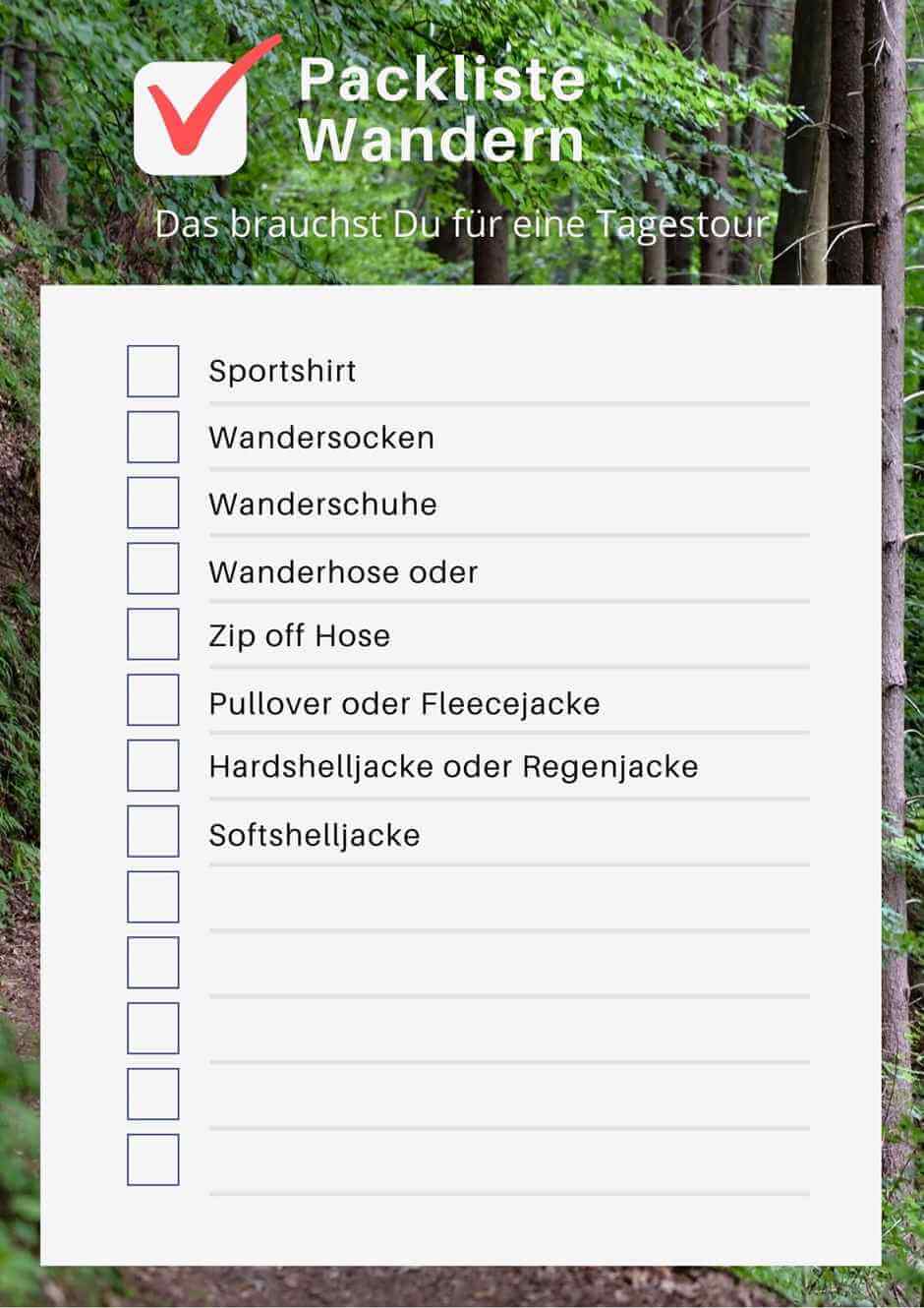
- Sports shirt *
- walking boots
- hiking socks
- Shorts for hiking
- Hiking pants * or Zip off pants *
- Pullover * or Fleece jacket *
- Hardshell jacket * or Rain jacket
- Softshell jacket *
If you purchase via a link marked *, we receive a commission, which we use to run this blog.

Backpack hiking for a day tour
You should definitely check these things in our hiking packing list. The size of the backpack depends, for example, on the hiking equipment you take with you. For short tours, for example, a small backpack is sufficient. However, for longer tours it needs to be larger. Safety equipment should also always be with you. Especially on rough hiking trails or mountain hikes, it's easy to twist your ankle and injure your leg. Anyone who has ever hiked with blisters knows how unpleasant it is. A blister plaster helps.
For orientation you will definitely need appropriate information material, a GPS device and a compass. We experienced how important someone like that is on our mudflat hike. The same goes for a headlamp. Plus, you can always get stopped on the road. If you find yourself in the dark while hiking, it's good to have both hands free. You should also take enough drinks with you. A hydration bladder is ideal for this. When we hike, we stick to the motto “Don’t leave anything behind that wasn’t there before.” That's why we always have garbage bags with us so we can take our waste home with us. They have no place on the hiking trail.
- backpack
- First aid kit *
- Rescue blanket *
- Blister plasters * or Silicone toe protection against blisters *
- Hiking maps for orientation. Apps like Outdooractive or Komoot are ideal for this.
- Compass *
- Hiking guide
- Headlamp *
- Water bottle or Hydration bladder *. This is also practical hydration bladder cleaning kit*.
- Utility knife *
- trash bags
- GPS device *
- Biodegradable Soap, Dishwashing Liquid and Garment Detergent* and refill bag *
If you purchase via a link marked *, we receive a commission, which we use to run this blog.
Take food with you on your hike
A hike isn't perfect if you don't stop for a snack along the way. Therefore, you should also think about these things:
- as well as a snack the einpack
- as well as a stainless steel can for lunch on the go
Packing list for hiking – What do you need for hiking in which season
Whether you should pack this hiking gear depends on the weather as well as the time of year your hike takes place. In autumn or winter you will of course need a hat, gloves or a scarf. However, the packing list for hiking on a summer vacation looks different. In summer, a baseball cap and a scarf protect against sunburn. As well as a sun hat, sunglasses and sun protection. For example, changing a shirt is pleasant on hikes that are more strenuous. If you like hiking quickly, you might like hiking poles? A rain cover for your backpack is also very practical. Then you can also pack your camera safely if a thunderstorm threatens.
- Outdoor pants *
- Cap * or Baseball cap *
- Scarf * or bandana
- Sports shirt to change
- sun hat or HEADBAND *
- Sunglasses *
- Sun protection * and Lip protection *
- Gloves *
- Walking sticks *
- Rain protection for the backpack *
If you purchase via a link marked *, we receive a commission, which we use to run this blog.

What else belongs on the hiking packing list?
Whether you need these things from our hiking packing list depends on your interests and your type of hiking. It also plays a role whether your hike leads into the mountains. It is often cool at the summit while it is hot in the valley. You don't have to have an outdoor watch. She's a nice toy. However, if your tour takes you over rough mountain paths, you will need safety equipment. When hiking after rainy days, the paths are often muddy. Gaiters definitely protect your legs from dirt. You move in nature. Tick tweezers are useful, as is a seat cushion that allows you to sit on even the hardest stones picnic.
- Insulation jacket * for summit regions
- Camera *
- Outdoor clock *
- Binoculars *
- Crampons * (depending on the condition of the trail)
- Leg protection *
- Tick pliers *
- Lighter *
- Inflatable seat cushion *
If you purchase via a link marked *, we receive a commission, which we use to run this blog.
🧒 Packing list for hiking with children
🎒 Equipment
Children's backpack (10–20 liters)* – well padded, with chest and hip straps
Signal whistle* – helps in emergencies, is also often used as a toy
Seat pad or small folding stool
Children's binoculars* or Magnifying glass* – makes the tour more exciting
Drinking bottle (leak-proof) – preferably with easy operation
Small lunch box with snacks – important for motivation and energy
Wet wipes & tissues – for small accidents on the go
Blister plasters & child-friendly first aid kit* – e.g. with colorful plasters
👕 Clothing
Hiking shoes for children* – ankle-high, waterproof, well broken in
Functional clothing – layered look! (Shirt, fleece, rain jacket)
Cap & sun hat
Sunglasses with UV protection
Change of clothes (depending on the weather + 1 more set)
🧸 Children's extras
Cuddly toy* or lucky charm – provides security and comfort
Mini-game or card game – for breaks or hut evenings
Crayon* or small drawing pad – for creative breaks
Tracking app or compass game – for older children, as motivation
🧼 Hygiene / Safety
Sun protection (children's sunscreen, SPF 50+)
Mosquito repellent (suitable for children)
Hand sanitizer or soap (biodegradable)
💡 Tips for parents
It is better to let them carry less; the weight should be no more than 10–15% of their body weight.
Children need more breaks, snacks and variety.
Packing together is motivating – let your child help decide!
👵👴 Hiking packing list for seniors
🎒 Basic equipment
Lightweight, ergonomic daypack (20–30 L)* – with good back system, padding & hip belt
Trekking poles (adjustable & cushioned)* – relieves knees and joints
Seat cushion or foldable stool – for comfortable breaks
Hiking map or GPS app (e.g. Komoot, Outdooractive) – set larger font!
Reading aid or mini magnifying glass – if maps or information are difficult to see
👟 Clothing & Shoes
Well-worn walking boots with high shaft & good profile
functional socks against blisters
Comfortable, breathable clothing in an onion look
Rain jacket / windbreaker
Hat or peaked cap + Sunglasses with UV protection
Light gloves (also useful in summer for sensitive skin)
🧴 Hygiene & Care
Sunscreen (SPF 50+, sensitive)
Blister plasters & tape
First aid kit with personal medication if necessary
Wet wipes, tissues & small hand sanitizer
Joint ointment or cooling gel – helpful for mild overexertion
🍎 Catering
Sufficient water (at least 1,5 L)
Electrolyte drink or magnesium tablets – prevents muscle cramps
Nutritious snacks (nuts, dried fruit, energy bars)
📱 Security & Technology
Mobile phone with emergency numbers & power bank
Medical emergency ID (e.g. on your mobile phone or as a card in your backpack)
Headlamp or small flashlight – in case it gets later
Whistle or small alarm pendant for emergency signaling
💡 Additional tips for the blog post:
Link to accessible paths or premium hiking trails with benches as a recommendation.
Tips for planning your walking time – it’s better to do shorter stages with more breaks.
Encouragement of hiking groups – ensures greater safety and sociability.
Packing list for hiking in preparation
With this hiking holiday packing list you will definitely not forget anything important, regardless of whether you are looking for a packing list for hiking on a multi-day tour or a packing list for hiking on a day tour.
By the way: Do you already know?
- Hiking in autumn in Germany
- Gifts for hikers
- Traveling with a motorhome - tips
- Winter vacation packing list
- packing list for a beach vacation or ours
- Checklist beach vacation
- Vacation packing list
- packing list for campers?
- Packing holiday
- Your camping packing list: Everything you need for camping
- Finance Holiday - Travel Blogger Tips
Source Hiking checklist: Research while hiking. Our opinions definitely remain our own.
Text packing list for hiking: © Copyright Monika Fuchs and TravelWorldOnline
Photos packing list hiking: © Copyright Monika Fuchs and TravelWorldOnline